
Most people who buy a bad leather jacket do not realize it until six months in. The zipper starts catching. The leather cracks along the collar. The lining bunches up inside the sleeves. By that point, the return window is long gone.
A good bomber jacket is one of the best wardrobe investments you can make. A bad one is just an expensive mistake. The difference comes down to a handful of things you can check before you buy – in person or online.
Here is what actually matters.
1. The Leather Grade – Start Here
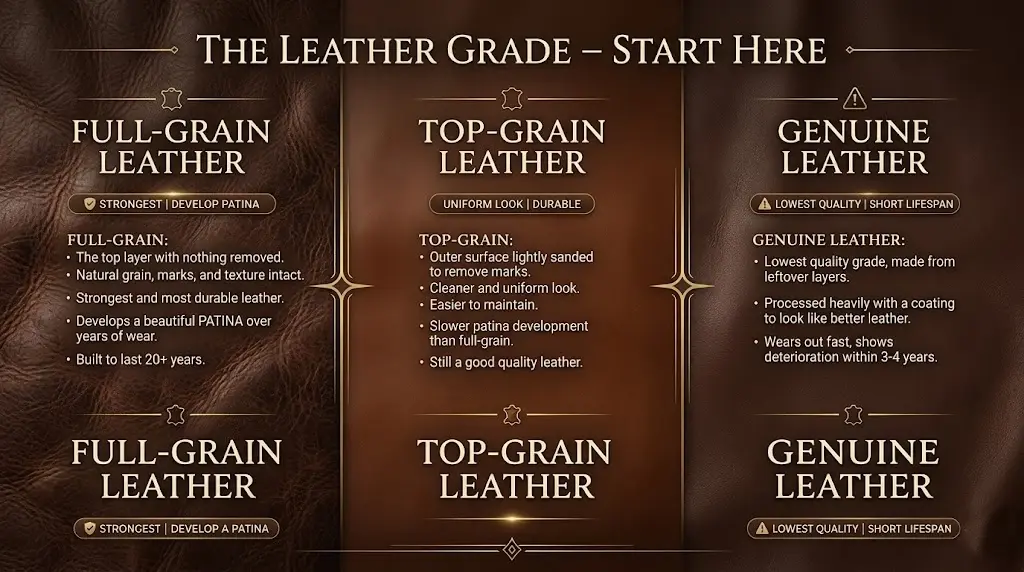
The leather is everything. Get this right and you have a jacket that lasts twenty years. Get it wrong and you will be shopping again in two.
Full-Grain Leather
Full-grain is the top layer of the hide with nothing removed. The natural grain, the subtle marks, the texture – all of it stays intact. It is the strongest, most durable leather you can buy. It also develops a patina over years of wear that makes it look better the longer you own it.
A full-grain or top-grain leather bomber bought today should still be a jacket worth wearing in fifteen years. That is not marketing. It is just how full-grain leather ages.
Top-Grain Leather
Top-grain leather has its outer surface lightly sanded to remove natural marks, then a finish coat goes on top. It looks cleaner and more uniform than full-grain, and it is easier to maintain. The trade-off is that the finish layer removes some of the character and the patina development is slower. Still a good leather – just not quite the same as full-grain.
Genuine Leather
Genuine leather sounds impressive but it is actually the lowest quality grade. It comes from the leftover layers of the hide after the top layers have been cut away. It is processed heavily, has a coating applied to look like better leather, and wears out fast. Most genuine leather jackets start showing serious deterioration within three to four years of regular wear.
If a jacket is advertised as “genuine leather” and costs under $150, that is the reason.
Common Leather Types Used in Bombers
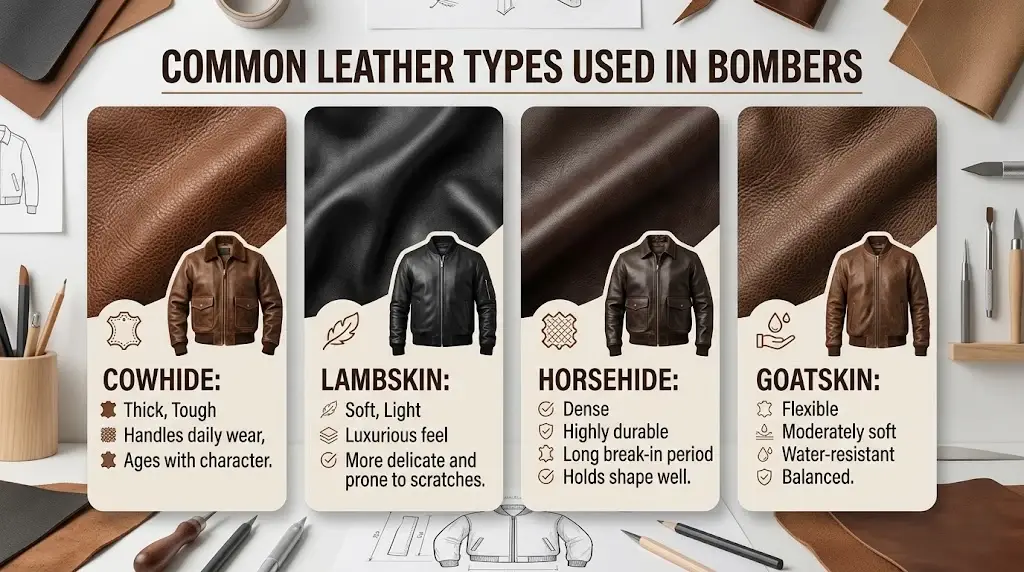
Cowhide is thick, tough, and the most common leather used in classic bomber shapes. It handles daily wear well and ages with visible character.
Lambskin is noticeably softer and lighter than cowhide. It feels luxurious against the skin from day one. The trade-off is that it is more delicate – more prone to scratches and scuffs than cowhide.
Horsehide is dense and very durable. It takes longer to break in but once it does, it holds its shape exceptionally well. Less common now but highly valued by people who know leather.
Goatskin sits between lambskin and cowhide – flexible, moderately soft, and naturally more water-resistant than most other leathers.
2. Stitching and Construction
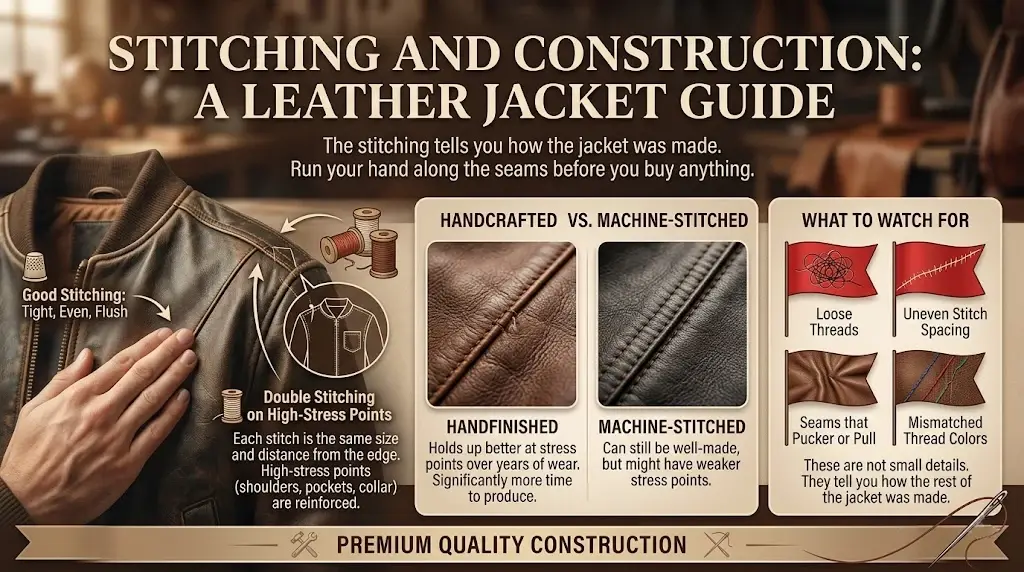
The stitching tells you how the jacket was made. Run your hand along the seams before you buy anything.
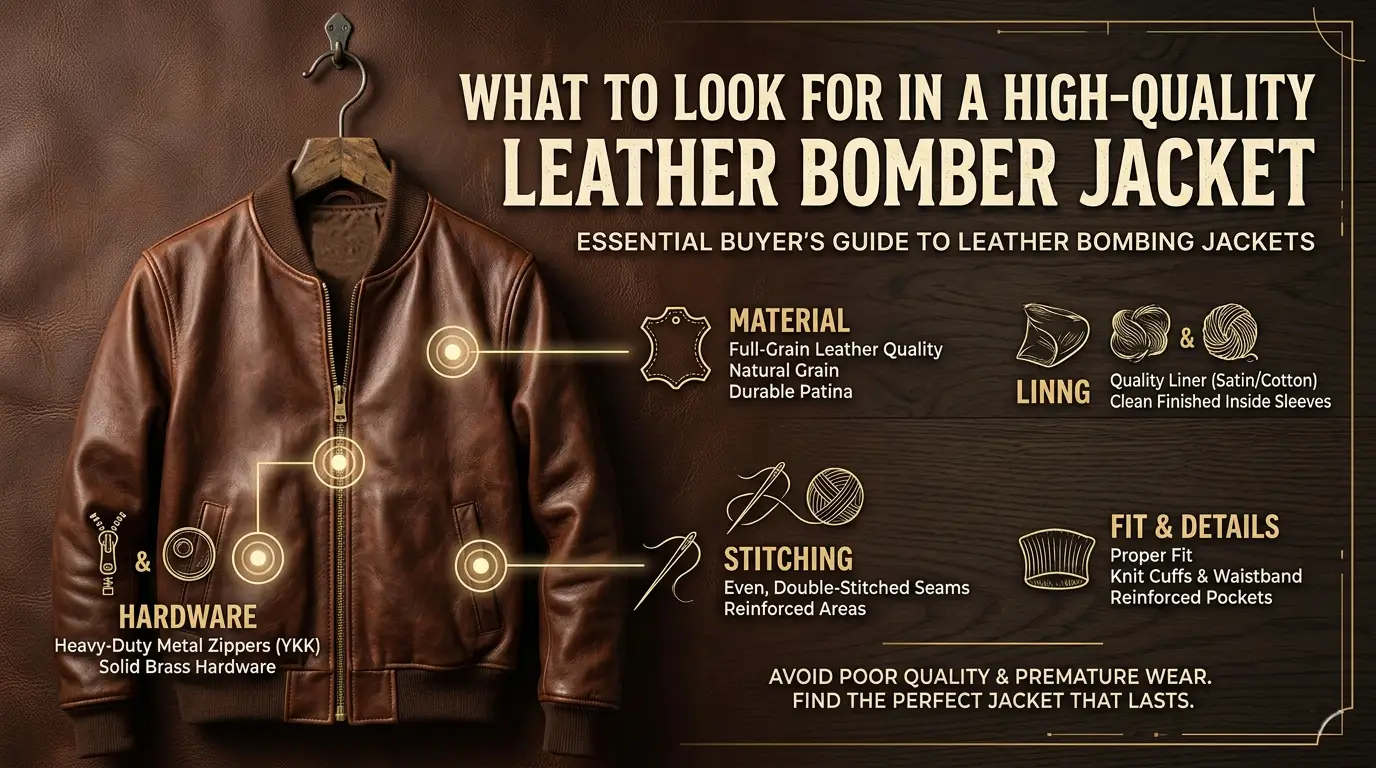
Good stitching is tight, even, and sits flush against the leather. Each stitch should be the same size and the same distance from the edge. Double stitching along high-stress points – shoulder seams, pocket openings, the collar attachment – is a sign the jacket was built to last.
What to watch for: loose threads anywhere, uneven stitch spacing, seams that pucker or pull, and thread colors that do not quite match the leather. These are not small details. They tell you how the rest of the jacket was made.
Handcrafted leather bombers take significantly more time to produce and the stitching quality shows it. A machine-stitched jacket can still be well made, but hand-finished seams tend to hold up better at the stress points over years of wear.
3. Hardware and Zippers
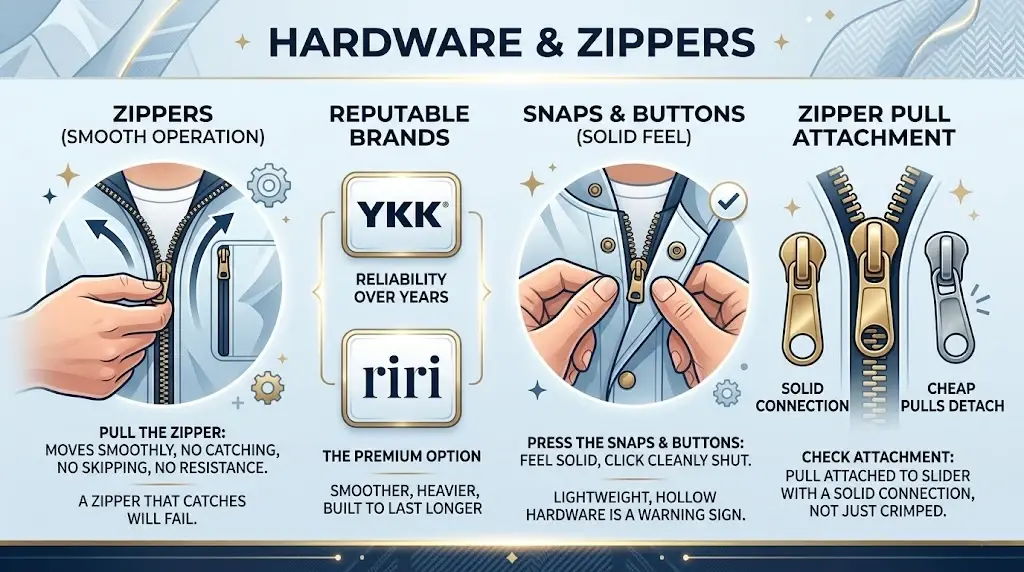
Pull the zipper on any jacket you are considering buying. It should move smoothly with no catching, no skipping, no resistance. A zipper that catches on day one will fail completely within a year.
YKK and RiRi are the two hardware brands worth knowing. YKK zippers are found on most quality jackets and are known for reliability over years of use. RiRi is the premium option used by high-end brands – smoother, heavier, and built to last even longer.
Press the snaps and buttons. They should feel solid and click cleanly shut. Lightweight hardware that feels hollow or cheap is a warning sign – it will loosen and fail.
Check that the zipper pull is actually attached to the slider with a solid connection, not just crimped on. Cheap zipper pulls detach within months on lower quality jackets.
4. The Lining
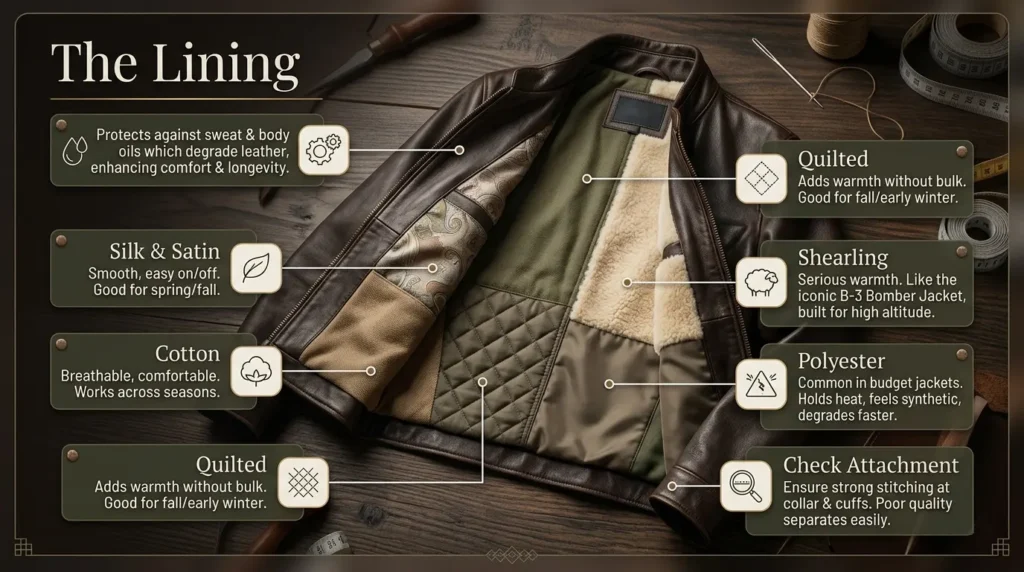
The lining affects how the jacket feels to wear and how long the leather itself lasts. A good lining protects the inside of the leather from sweat and body oils, which degrade leather over time.
Silk and satin linings feel smooth and allow the jacket to slide on and off easily. Good for spring and fall wear.
Cotton linings are breathable and comfortable. They do not trap heat and work well across seasons.
Quilted linings add warmth without significant bulk. Good for fall and early winter use.
Shearling linings provide serious warmth. The B-3 Bomber Jacket is the most famous example – built for pilots at 25,000 feet and lined entirely in sheepskin for that reason. For a full breakdown of shearling and fur options, our fur and shearling bomber guide covers every style and warmth level in detail.
Polyester linings are the most common in budget jackets. They hold heat, feel synthetic against the skin, and degrade faster than natural linings.
Check the lining at the collar and cuffs where it attaches to the leather. If it is already separating or poorly stitched in a new jacket, it will detach completely within a year.
5. Fit and Structure
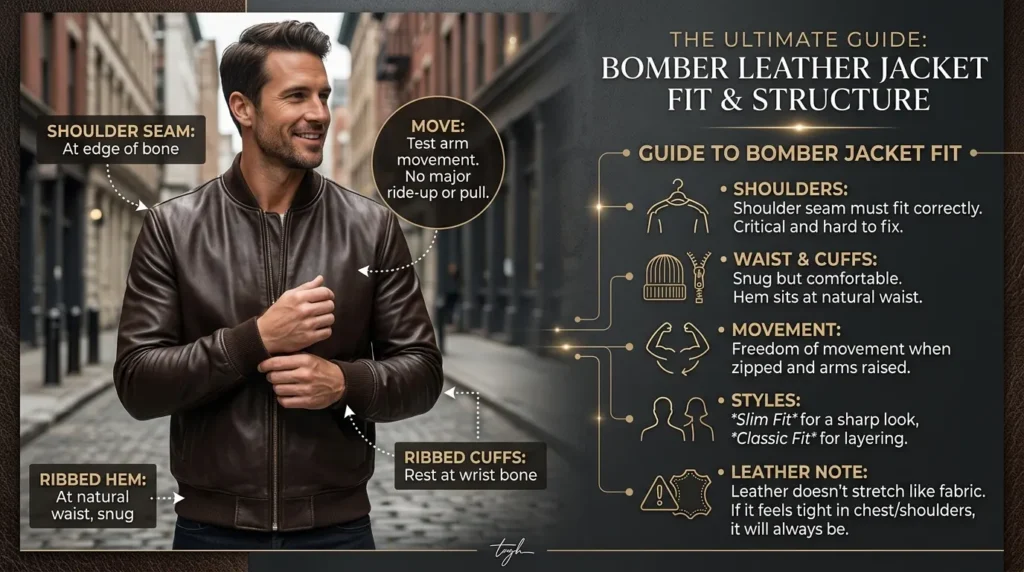
A well-fitted bomber leather jacket should feel comfortable from the first try, not something you need to break into. The shoulder seam sits at the edge of the shoulder bone – not hanging down the arm, not pulling inward.
The ribbed hem should sit at your natural waist, snug enough to hold the jacket’s shape but not tight enough to dig in. The ribbed cuffs should rest at your wrist bone.
Zip it up. Move your arms forward. The jacket should follow your movement without the back riding up significantly or the chest pulling.
Slim-fit bombers are cut closer to the body for a sharper silhouette. Classic fit bombers have more ease for layering. Neither is wrong – the key is that the shoulders fit correctly regardless of the body style. Shoulders that are off cannot be fixed without expensive tailoring.
One practical note: leather does not stretch like fabric. If a leather jacket feels tight in the chest or shoulders when you try it on, it will always feel tight. Do not buy hoping it will loosen with wear.
6. Smell and Touch Tests
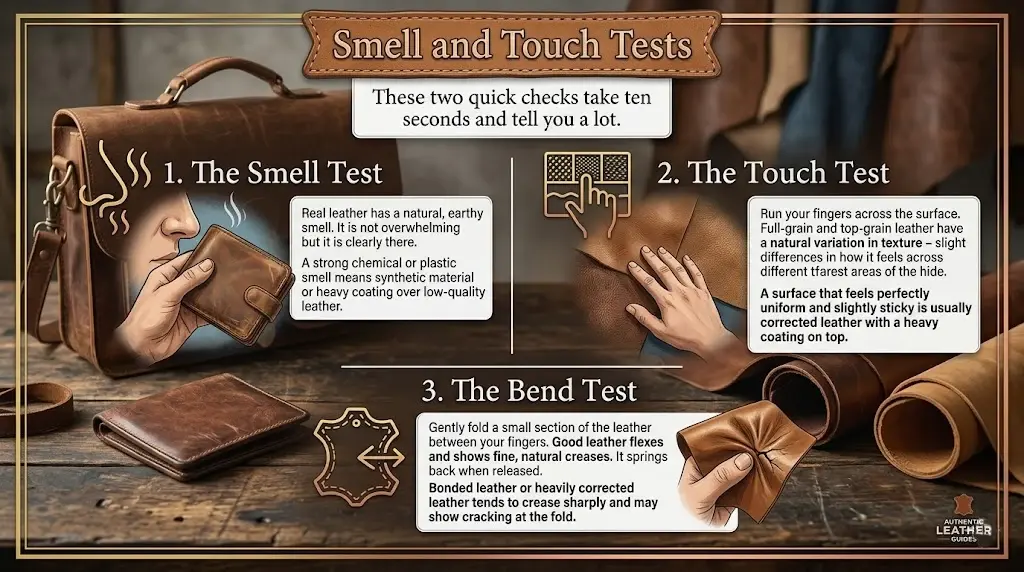
These two quick checks take ten seconds and tell you a lot.
The smell test: Real leather has a natural, earthy smell. It is not overwhelming but it is clearly there. A strong chemical or plastic smell means synthetic material or heavy coating over low-quality leather.
The touch test: Run your fingers across the surface. Full-grain and top-grain leather have a natural variation in texture – slight differences in how it feels across different areas of the hide. A surface that feels perfectly uniform and slightly sticky is usually corrected leather with a heavy coating on top.
The bend test: Gently fold a small section of the leather between your fingers. Good leather flexes and shows fine, natural creases. It springs back when released. Bonded leather or heavily corrected leather tends to crease sharply and may show cracking at the fold. For a deeper look at spotting real leather versus faux, our real vs faux leather bomber jacket guide covers every test in more detail.
7. Red Flags to Watch For
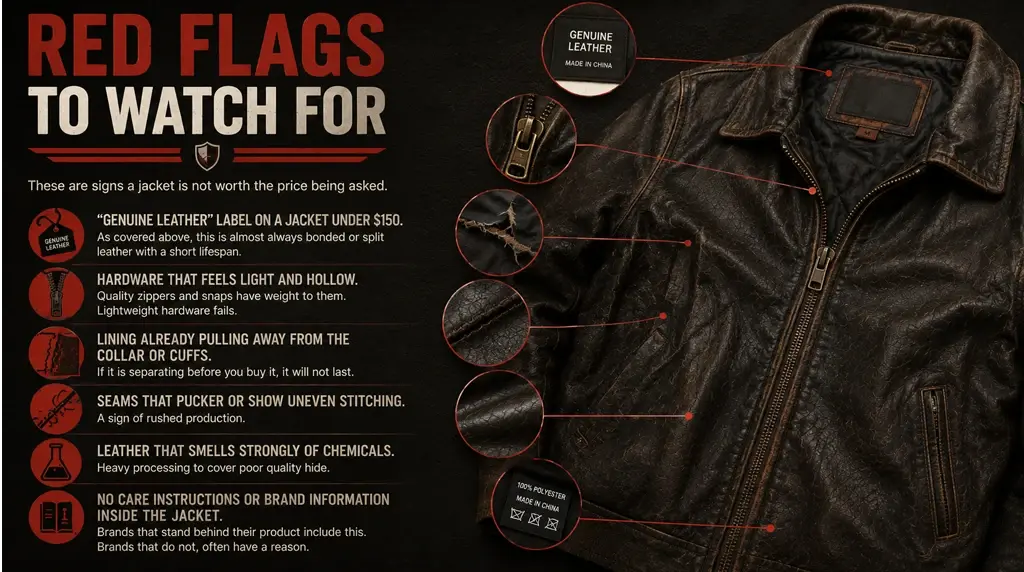
These are signs a jacket is not worth the price being asked.
“Genuine leather” label on a jacket under $150. As covered above, this is almost always bonded or split leather with a short lifespan.
Hardware that feels light and hollow. Quality zippers and snaps have weight to them. Lightweight hardware fails.
Lining already pulling away from the collar or cuffs. If it is separating before you buy it, it will not last.
Seams that pucker or show uneven stitching. A sign of rushed production.
Leather that smells strongly of chemicals. Heavy processing to cover poor quality hide.
No care instructions or brand information inside the jacket. Brands that stand behind their product include this. Brands that do not, often have a reason.
8. Price and What It Tells You
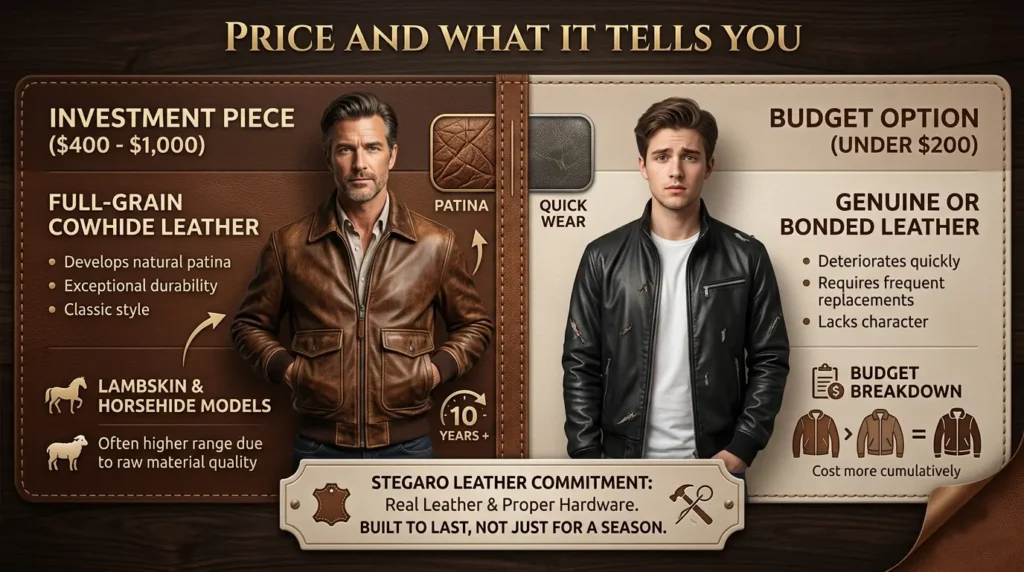
A quality full-grain cowhide bomber jacket costs between $400 and $1,000 depending on the leather type and construction. Lambskin and horsehide versions often sit at the higher end of that range because of the quality of the raw material.
Under $200 for a “leather” bomber almost always means genuine leather or bonded leather. These jackets look fine initially but deteriorate quickly. Over a ten-year period, buying two or three cheap jackets costs more than one quality full-grain jacket – and you never get the patina and character that comes from wearing a good leather jacket for years.
At Stegaro Leather, every jacket is built with real leather and proper hardware because a jacket should last long enough to become yours – not just something you wear for a season.
Quick Reference Checklist Before You Buy
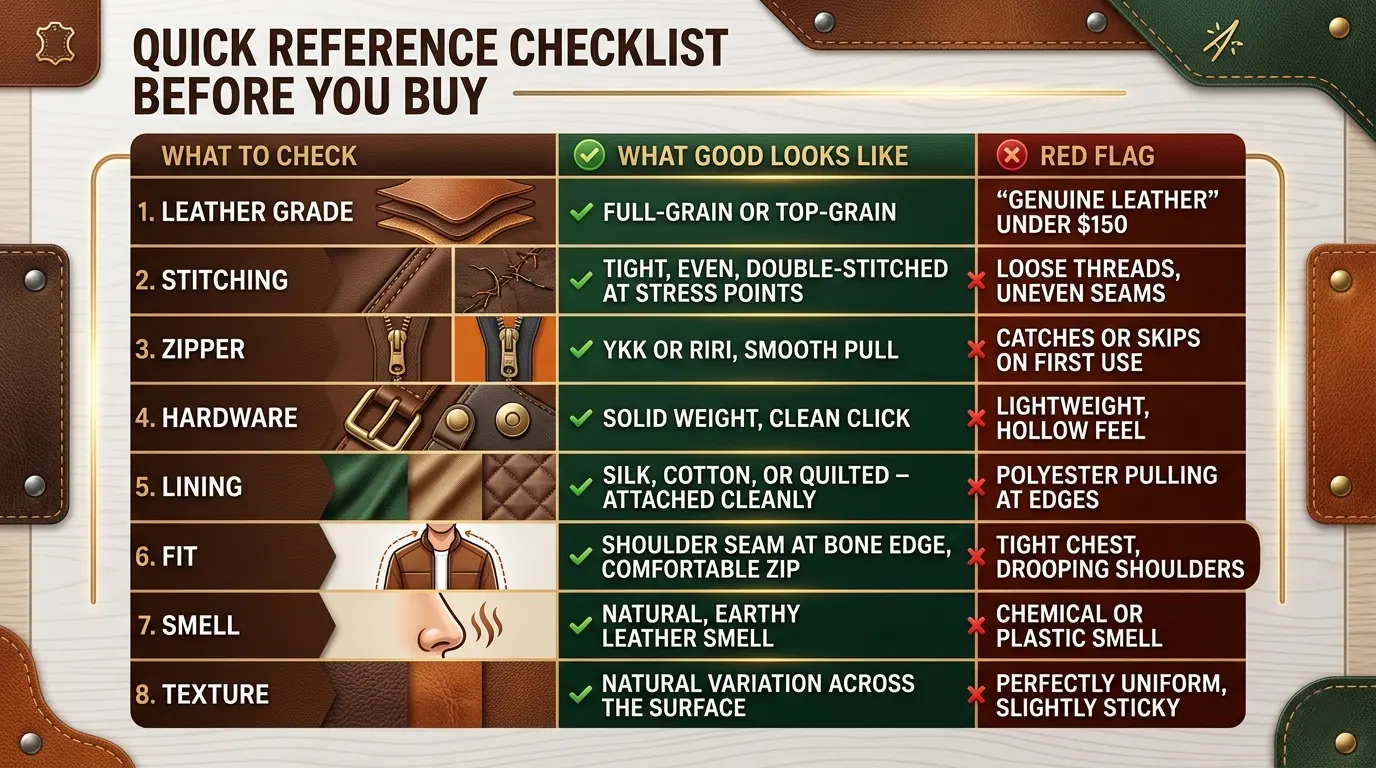
| What to Check | What Good Looks Like | Red Flag |
| Leather grade | Full-grain or top-grain | “Genuine leather” under $150 |
| Stitching | Tight, even, double-stitched at stress points | Loose threads, uneven seams |
| Zipper | YKK or RiRi, smooth pull | Catches or skips on first use |
| Hardware | Solid weight, clean click | Lightweight, hollow feel |
| Lining | Silk, cotton, or quilted – attached cleanly | Polyester pulling at edges |
| Fit | Shoulder seam at bone edge, comfortable zip | Tight chest, drooping shoulders |
| Smell | Natural, earthy leather smell | Chemical or plastic smell |
| Texture | Natural variation across the surface | Perfectly uniform, slightly sticky |
Final Thoughts
A leather bomber jacket is worth spending real money on once and keeping for years. The things that separate a jacket worth that investment from one that is not are all checkable before you buy – the leather grade, the stitching, the hardware, the lining, and the fit.
Get those right and you will have a jacket that wears in rather than wearing out. One that looks better at year five than it did on the first day.
That is what a real leather bomber is supposed to do.
FAQs
Check four things: the leather grade label, the stitching at the seams, the zipper pull, and the lining attachment at the collar. Full-grain or top-grain leather, tight double stitching, a YKK or RiRi zipper, and a lining that sits cleanly without pulling – these are the signs of a jacket built to last.
From best to worst: full-grain, top-grain, genuine leather, split leather, and bonded leather. Full-grain keeps the entire outer hide intact. Top-grain is lightly buffed and finished. Genuine leather comes from lower hide layers. Split leather is the leftover middle layer. Bonded leather is ground-up scraps glued together – it peels within a few years.
Full-grain cowhide for durability and long-term character. Lambskin if you want something lighter and softer from day one. Horsehide if you want the densest, most long-lasting leather available. All three are good – it depends on how you plan to wear it and how much break-in time you are willing to give it.
Both are soft, fine-grained leathers from young animals. Lambskin is lighter and has a slightly silkier feel. Calfskin is a bit firmer and more durable. For a bomber jacket you plan to wear regularly, calfskin holds up better over time. For something you want to feel luxurious from the first wear, lambskin has the edge.
Three quick tests. First, smell it – real quality leather has a natural earthy smell, not a chemical one. Second, touch it – the surface should have subtle texture variation, not a perfectly uniform feel. Third, bend a small section gently – quality leather shows fine natural creases and springs back. Cheap leather cracks or creases sharply and stays creased.
Weight and feel give it away immediately. A quality leather jacket has noticeable substance – not heavy but solid. The zipper moves smoothly with no catching. The stitching is clean and even at every seam. The lining sits flat and feels like a natural material, not polyester. These things together tell you more than the price tag.
Cheap leather – usually genuine or bonded – often has a slightly plasticky smell, a perfectly uniform surface texture, and a thin feel in the hand. The zipper tends to be lightweight and catches. The lining is almost always polyester. Bend the leather gently – cheap leather creases sharply rather than showing natural, soft folds.
For a leather bomber, full-grain cowhide is the best all-round material. It is durable, ages well, and works across all seasons. For a non-leather bomber, heavyweight nylon is the traditional choice – the original MA-1 was nylon and it has held up for decades. For warmth, a shearling-lined bomber in full-grain leather covers both bases.
Start at the shoulders – the seam should sit exactly at the edge of the shoulder bone. Move to the chest – the zipper should move smoothly and the fabric should not pull when zipped. Check the stitching at every seam for evenness. Smell the leather. Look at the lining where it attaches to the collar. All of these together give you a complete picture of how the jacket was made.
Neither extreme. A bomber jacket should have comfortable ease in the body – enough to layer a thin knit underneath – but the shoulders need to fit correctly. The shoulder seam should sit at the edge of your shoulder bone. The chest should zip without pulling. If it feels tight in the shoulders or chest when you try it on, it will always feel tight – leather does not stretch like fabric.
At $300 you are at the lower end of genuine quality leather. You can find a good top-grain leather bomber in that range if you choose carefully – look for a known brand, check the hardware, and verify the leather grade. Below $200 for a leather bomber almost always means genuine leather or bonded leather, which will not last. At $400 to $600 you are firmly in full-grain territory where the jacket is genuinely built to last decades.
Yes. The leather bomber is one of those silhouettes that does not really go in and out of style the way trend pieces do. It has been a wardrobe staple since the 1950s. In 2026, chocolate brown and cognac leather bombers are particularly strong alongside classic black. The relaxed silhouette also fits well with how most people dress day to day right now.