
You see the jacket first. The leather comes second.
Maybe it is the deep black color, the silver zipper, the fitted waist, or that slightly glossy finish that catches your eye. That is completely normal. When shopping for a women’s biker jacket, the design often makes the first impression. But the material determines whether that beautiful jacket will still feel and look good after months of wear.
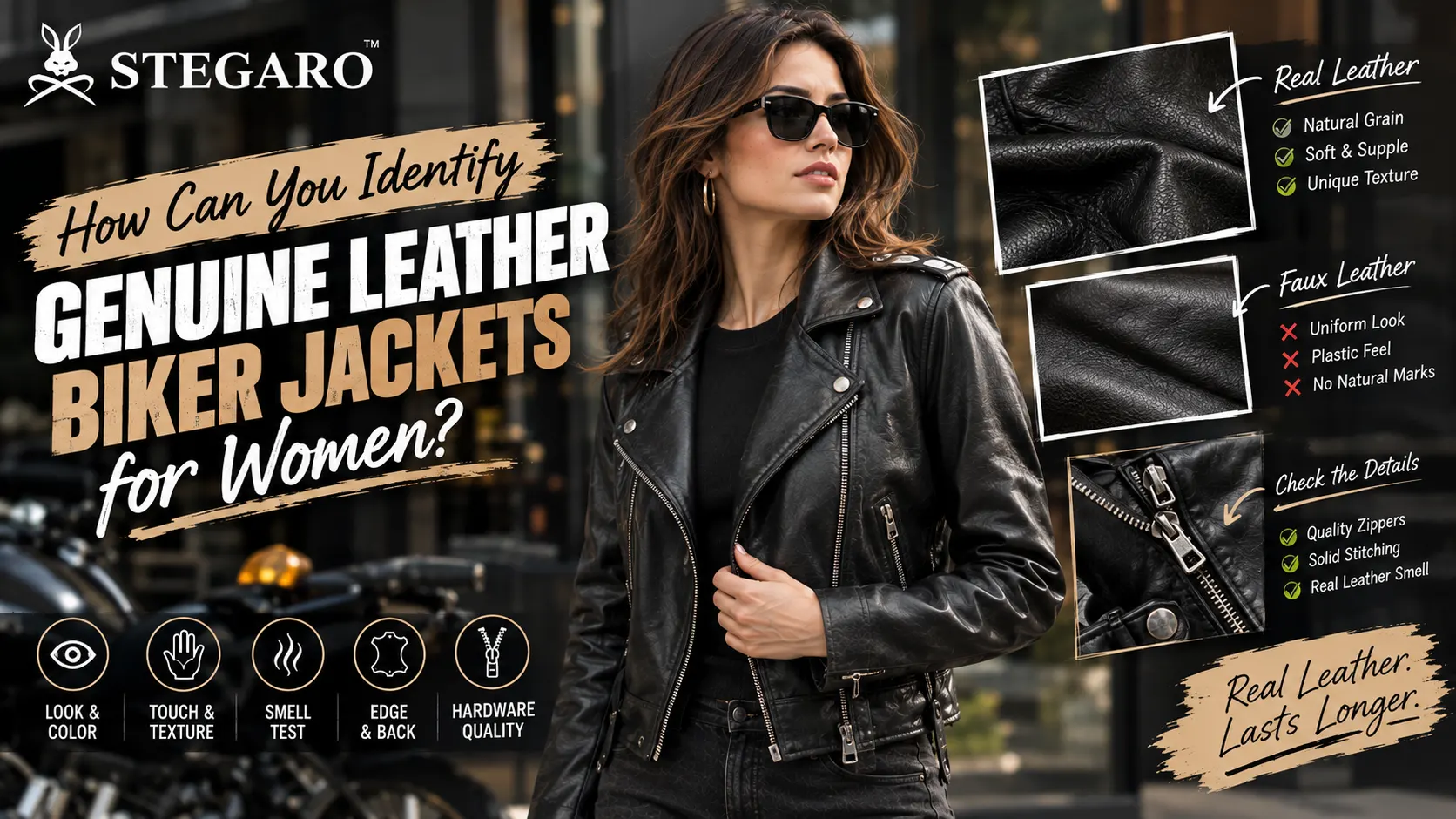
So, how can you tell whether the jacket you love is actually leather?
The good news is that you do not need to memorize complicated leather terminology. You just need to know what to look for. With a few simple checks, you can learn to spot genuine leather, recognize convincing faux leather, and avoid paying a leather-jacket price for a plastic-based material.
A genuine leather biker jacket womens shoppers choose should have clear material information. However, do not stop at the words “genuine leather.” That phrase tells you the material is real leather, but it does not automatically tell you that it is the highest grade or best-quality leather. Leather can differ by hide, grain, finishing, thickness, and construction.
Why Does the Material Matter More Than the Finish?
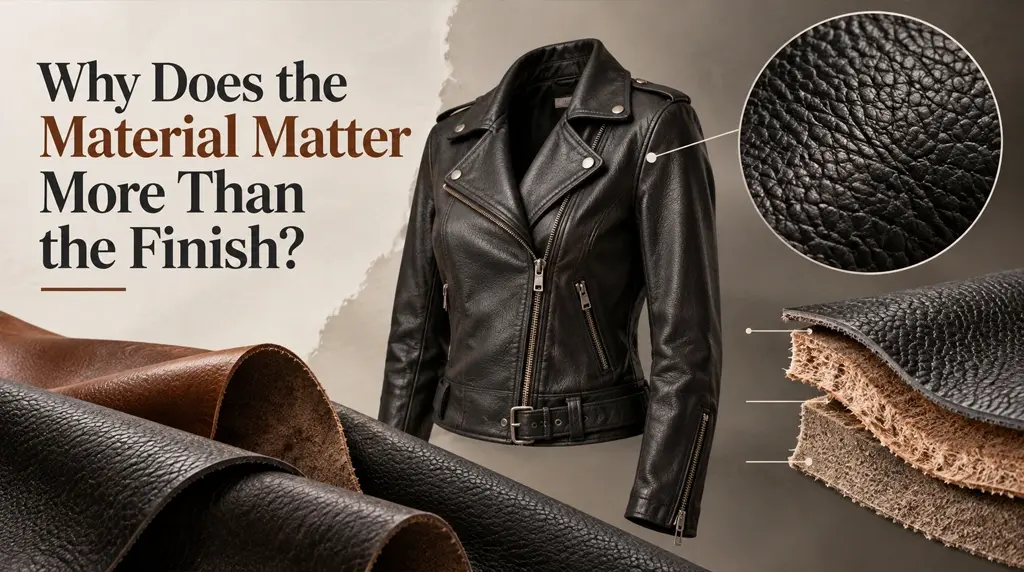
Imagine finding the perfect biker jacket. The color is gorgeous. The cut is flattering. The hardware looks expensive. You try it on and think, “This is the one.”
Then you discover that the material is synthetic.
That does not automatically mean the jacket is bad. Faux leather can look attractive and can be a perfectly reasonable choice. The problem arises when a jacket is falsely presented as real leather.
That is why it helps to separate appearance from material.
A shiny finish does not prove that a jacket is leather. Neither does a matte finish prove that it is fake. The same goes for color. Black, brown, burgundy, cream, pink, and other colors can all be produced in genuine or synthetic materials.
The trick is to look underneath the fashion details and examine what the jacket is actually made from.
What Does “Genuine Leather” Really Mean?
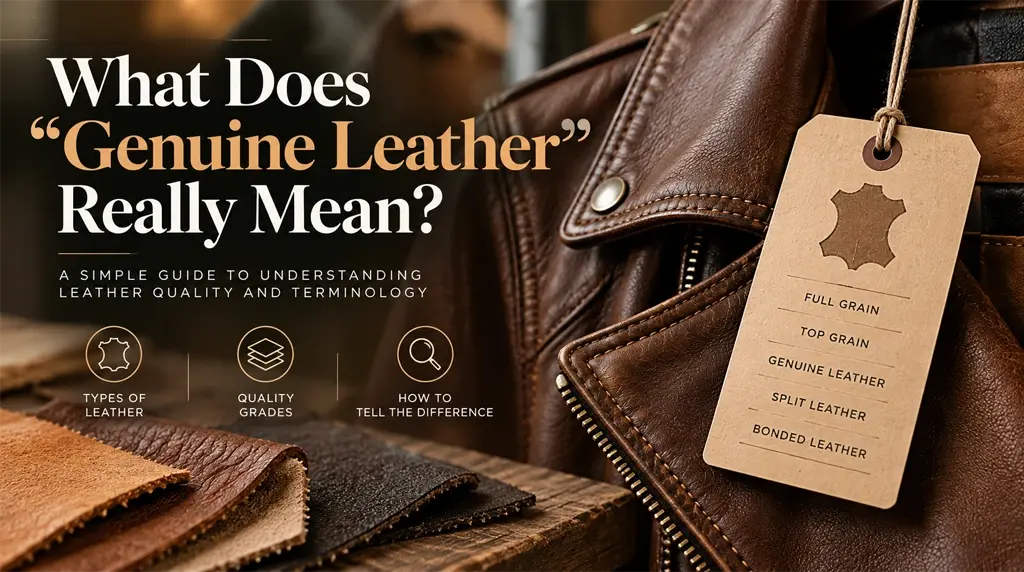
This is the first thing every woman shopping for a leather jacket should understand.
Genuine leather means the material is real leather. It does not mean “the most luxurious leather available.”
Leather can be produced from different parts of an animal hide and can receive various treatments. Full-grain leather retains the natural grain surface, while corrected-grain leather may have its surface altered. Split leather comes from lower layers of the hide.
So if a product description says only “genuine leather,” you know something useful about the material, but you still have questions to ask about its type and quality.
This matters when comparing a genuine leather biker jacket women shoppers may find in several styles and price ranges.
| Do not assume that the most expensive-looking jacket is the most authentic. And do not assume that a lower-priced jacket is automatically fake. Learn to inspect the material instead. |
7 Easy Ways to Tell If a Women’s Leather Biker Jacket Is Real
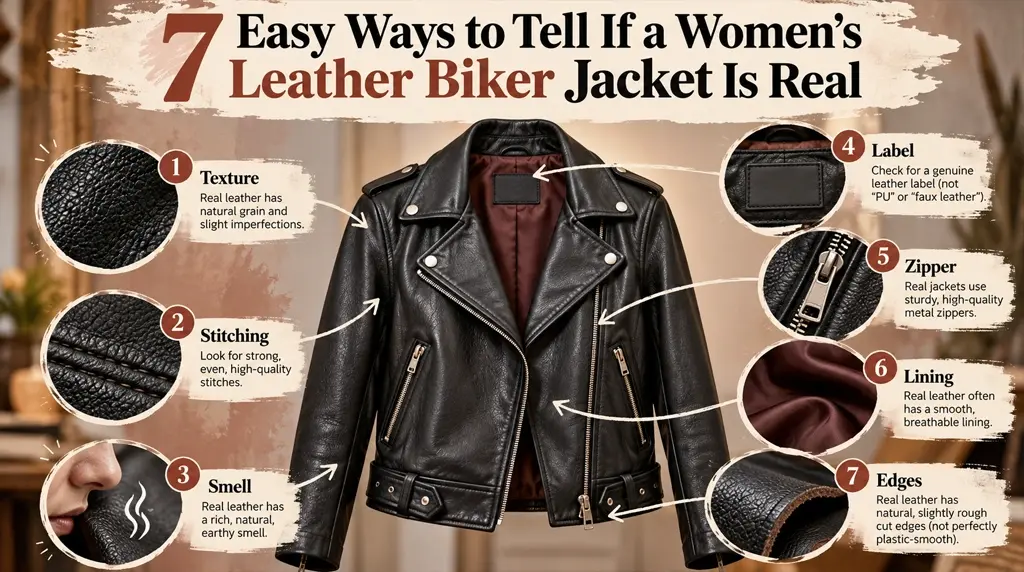
1. Read the Label Before You Fall in Love With the Jacket
Yes, the label is less exciting than the color or that gorgeous asymmetric zipper. Read it anyway.
Look for terms such as:
- Genuine leather
- Real leather
- Cowhide
- Lambskin
- Sheepskin
- Goatskin
- Full-grain leather
- Top-grain leather
Be careful with terms such as:
- PU leather
- Polyurethane
- Synthetic leather
- Faux leather
- Vegan leather
- Man-made leather
These describe materials that are not conventional animal leather.
If the listing simply says “leather look” or “leather finish,” stop and investigate. Those phrases do not give you the same information as a clear leather-material description.
A reliable seller should be able to tell you what the outer material actually is.
2. Touch It: Your Hands Can Notice What Your Eyes Miss
This is where your shopping instincts become useful.
Run your fingers across the jacket.
Real leather can feel soft, firm, supple, smooth, waxy, or slightly textured depending on the hide and finish. It does not have to feel rough to be genuine. Lambskin, for example, can feel remarkably soft. See why soft leather biker jackets feel so comfortable.
When you press or gently flex natural leather, the surface may develop temporary wrinkles or changes in texture.
Faux leather can also be very convincing, though. That is why “it feels real” should never be your only test.
Think of texture as one clue in your investigation.
3. Look Closely at the Surface
Now forget the overall color and inspect the surface itself.
Natural leather may have slight variance in the grain, pores, wrinkles and texture. Because leather is a natural material, these differences will not always be on each panel.
However, do not make the common mistake of thinking that every authentic leather jacket must have obvious scars or random marks. Modern leather can be corrected, embossed, polished, coated, or otherwise finished.
Instead, look for an unnaturally repetitive pattern.
If the same tiny grain pattern appears again and again with almost machine-perfect regularity, it may indicate an embossed synthetic surface.
4. Run the Smell Test: But Don’t Let Your Nose Make the Final Decision
Real leather usually has a natural earthy smell. Faux leather, however, might smell stronger of chemicals, plastic, or glue.
Sounds simple, right?
Not quite.
Finishes, dyes, adhesives, packaging, and storage can change the smell of a jacket. Some synthetic materials are also manufactured to smell more like leather.
So, if your genuine leather biker jacket womens smells strongly of leather, that is a useful clue. It is not proof. And if it does not smell like a leather store, that does not automatically make it fake.
5. The Water Test Is a Clue, Not a Lie Detector
You have probably seen this test online: place a drop of water on the jacket and see what happens.
Leather is a porous natural material, so untreated leather can absorb a small amount of water. Synthetic surfaces may cause the drop to bead up.
But there is an important catch.
Many leather jackets are finished or coated, and those treatments can change how water behaves. A genuine leather jacket may therefore repel a small drop instead of absorbing it immediately.
If you own the jacket and want to try the test, use only a tiny amount in an inconspicuous place and follow the care instructions first.
Never soak a jacket just to prove that it is real. Your leather jacket does not need a science experiment thrown at it.
6. Look Inside the Jacket
This is one of the best tricks for a fashion-focused shopper because you are moving beyond the pretty exterior.
Look at the inside of the jacket, particularly around seams, pocket openings, cuffs, and other areas where the construction may be visible.
Where an edge is exposed, genuine leather has a natural fibrous structure. Synthetic materials often have a manufactured backing underneath the surface.
Then check the stitching.
Are the seams straight? Are the stitches secure? Does the lining sit neatly? Do the pockets feel properly attached?
These details will not prove that the material is genuine, but they tell you whether the genuine leather biker jacket women was carefully constructed.
This leads us to an essential point: real leather does not inevitably equal good quality.
7. Check the Zippers, Snaps, and Other Hardware
Biker jackets are famous for their hardware.
That means you have another easy area to inspect.
Move the zipper up and down. Test the snaps. Look at the buckles and studs. Good hardware should feel secure and work smoothly rather than catching, rattling excessively, or feeling flimsy.
But remember: expensive-looking hardware does not prove genuine leather.
A synthetic jacket can have excellent metal hardware. A genuine leather jacket can also have inexpensive hardware.
Use hardware to judge construction, not to authenticate the leather by itself.
The Biggest Mistake Women Make When Shopping for Leather Jackets
Focusing only on how the jacket looks. And honestly, it is easy to understand why.
A beautiful color can stop you mid-scroll. A cropped biker silhouette can look fantastic. A polished finish can make a jacket appear expensive. Gold hardware can entirely change the mood of an outfit.
But none of those things tell you what is underneath.
Before buying a women’s genuine leather moto jacket, ask four simple questions:
- What is the outer material?
- What type of leather is it?
- How is the jacket constructed?
- Does the fit work for my body?
If the seller cannot answer the first two clearly, that is a reason to investigate further.
Genuine Leather Does Not Mean High Quality
This distinction deserves its own section because it is where many buyers get confused.
| What You Check | What It Tells You |
| Material label | Whether the jacket is described as real leather |
| Leather type | What hide was used |
| Grain | How the leather surface has been processed |
| Finish | How the surface has been treated |
| Stitching | Construction quality |
| Hardware | Construction and durability clues |
| Lining | Comfort and finishing |
| Fit | How well the jacket works on your body |
A jacket can be genuine leather and still have poor stitching or cheap hardware. Likewise, a well-made faux-leather jacket can look excellent and last reasonably well.
So do not confuse authenticity with quality. They are related, but they are not the same thing. Our black leather biker jacket buying guide shows what else to check.
How Should a Genuine Leather Biker Jacket Womens Fit?
Once you know the material is genuine, turn your attention back to yourself.
A women’s genuine leather moto jacket should allow comfortable movement without looking excessively loose or pulling across the body.
Check the shoulders first. The seam should sit close to your natural shoulder rather than hanging far beyond it.
Then check the bust and waist. Zip the jacket if you intend to wear it closed. If the zipper pulls sharply across your chest, the jacket may be too small.
Finally, move your arms forward and bend your elbows.
Leather can soften with wear, but do not buy a jacket that is already uncomfortably tight because you are hoping it will magically become a larger size.
A good women’s genuine leather motorcycle jacket should feel structured without restricting normal movement. For a full fit checklist, read our fitted biker jacket guide.
A Simple 60-Second Leather Check
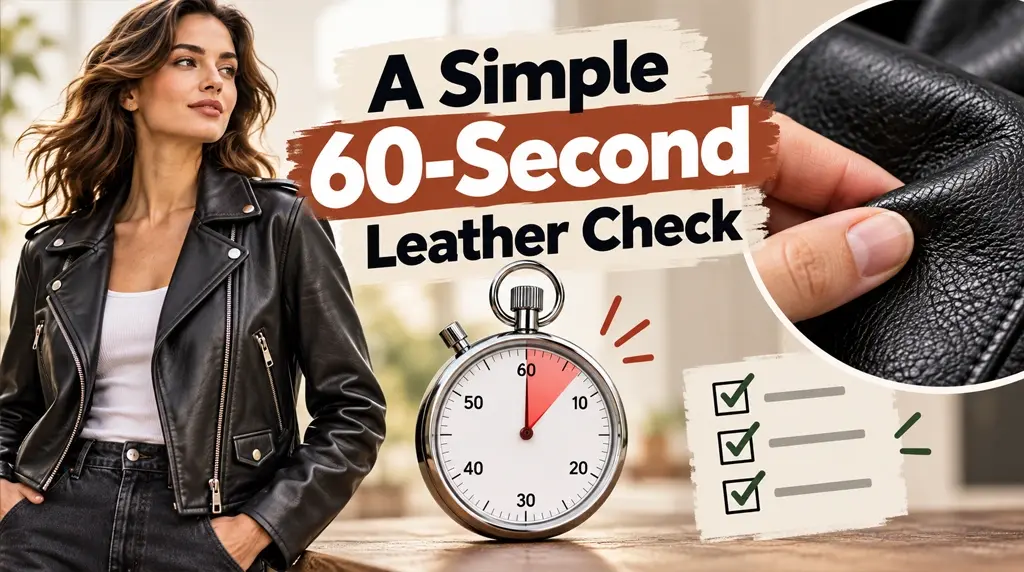
Before buying, save this checklist:
- Read the material label
- Look for a specific leather type
- Examine the grain closely
- Feel the surface
- Check exposed edges and backing
- Inspect the stitching
- Test the zipper and hardware
- Check the lining
- Read the care instructions
- Check actual garment measurements
- Compare several details before deciding
They can provide clues, but the label, construction, material information, and physical inspection give you a much stronger overall picture.
Final Thoughts
You do not need to become a leather expert to buy a genuine leather biker jacket womens with confidence. You simply need to slow down before the design wins you over.
Look past the color. Feel the material. Read the label. Check the grain. Look inside. Examine the stitching and hardware. Then think about the fit.
The next time a gorgeous biker jacket catches your eye, enjoy the color and the silhouette, but give the material a little attention too.
Because the best women’s genuine leather motorcycle jacket is not simply the one that looks beautiful on the hanger. This is the one where the material, the craftsmanship, the fit and the style all make sense when you look a bit closer. Stegaro‘s genuine leather biker jackets are built with exactly that attention to material, craftsmanship, and fit.
FAQs
Begin with the label and material description. Look for genuine leather or a specific hide like cowhide, lambskin, or goatskin. Then check the grain, feel the surface, look at exposed edges, and examine the backing and construction. You can also see how water acts and smells. But there is no one test that tells you if something is authentic or not.
Look at the cut rather than relying only on the label. Women’s jackets often have more shaping through the waist and different proportions around the shoulders, bust, sleeves, and hips. Men’s jackets are commonly straighter through the body. But they are designed standards, not laws of thumb. The right jacket is one that fits your body comfortably and gives you the silhouette you want.
Start with the material label, then examine the surface, edges, backing, stitching, and lining. If you are inspecting it yourself, look for several signs rather than relying on one test. Clear photographs of the material label, surface close-up, exposed edge, stitching, and inside backing can also help when asking a leather specialist for an opinion.
Keep it simple. Find out what material and leather type were used. Then check the stitching, lining, seams, zipper, snaps, pocket construction, and overall feel. A good jacket should feel thoughtfully made, not merely attractive in photographs.
Look beyond the words “genuine leather.” Find out the leather type and, where available, the grain or construction. Then examine the surface, stitching, lining, hardware, finishing, and fit. A high-quality jacket is a combination of good material and good workmanship. Authentic leather alone does not guarantee either one.