
Choosing leather jackets sounds simple until you start reading the labels. Then suddenly you are comparing hides, grains, finishes, weights, and tanning methods as if you are studying for a leather exam.
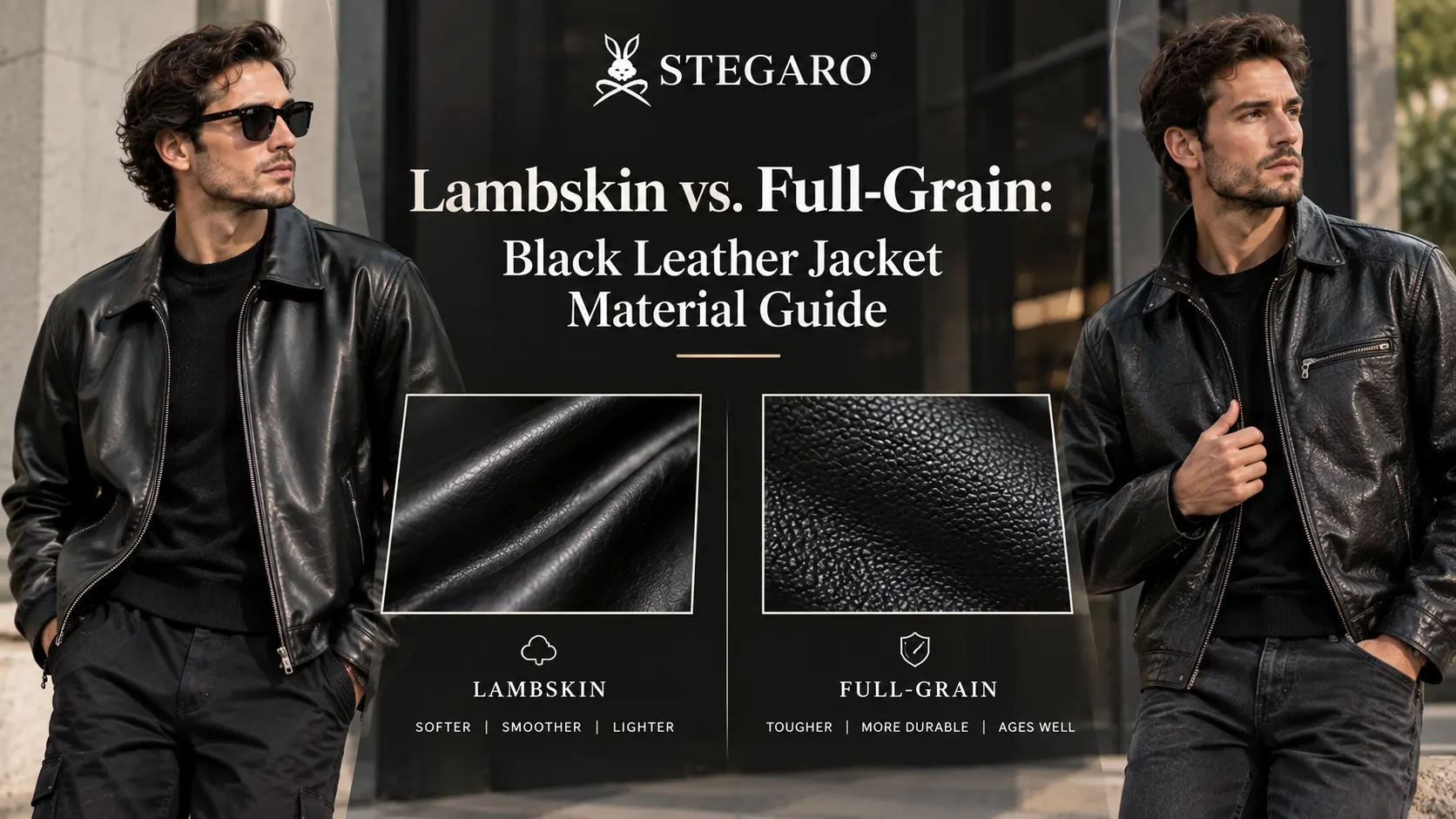
The confusion gets bigger with black lambskin leather and full-grain leather. They are often presented as competing materials, but they are not quite the same thing. Lambskin tells you where the leather comes from, while full-grain describes how the surface of the leather has been treated. In fact, a lambskin can also be full-grain.
So, which one should you choose for a jacket? The answer depends on how you wear your leather, how much softness you want, and whether durability or comfort matters more. Let’s break it down without turning your next jacket purchase into a science project. But first, let’s look at a quick comparison between these two leather jackets.
Black Lambskin vs. Full-Grain: Quick Comparison
| Feature | Black Lambskin Leather | Full-Grain Leather |
| What it describes | Animal/source of the skin | Amount of natural grain retained |
| Feel | Very soft and supple | Firmer and more substantial |
| Weight | Usually lightweight | Often medium to heavyweight |
| Comfort | Excellent from first wear | Improves with break-in |
| Natural grain | Can be fine and smooth | Entire grain remains intact |
| Durability | Good, but more delicate | Generally excellent |
| Break-in period | Minimal | Usually longer |
| Aging | Can develop character with care | Often develops a pronounced patina |
| Best for | Fashion, comfort, refined styles | Long-term wear, rugged styles |
| Care | Requires gentle handling | Generally more forgiving |
The important detail is that this table compares two different characteristics. A jacket could be made from black lambskin leather and still be full-grain if its entire grain surface has been retained.
What Is Black Lambskin Leather?
It is made of the skin of young sheep or lamb. The main attraction is its silky, soft texture. In general, the fibers are finer than those of heavier hides, helping to create a lightweight leather that drapes easily.
It is that softness that makes lambskin black leather jacket styles popular in fashion. They can be comfortable almost immediately rather than needing weeks of wear to soften.
There is also something remarkable about how black lambskin looks. The black finish can also assist in highlighting its smoothness and faint sheen, giving the jacket a professional aspect without making it appear overly formal.
However, everything comes with a cost. Lambskin is less resistant to scratches, scuffs, and hard abrasion than heavier-weight leathers. That doesn’t mean it’s flimsy or not fit for everyday wear. It just means you have to be a little more gentle with it.
Pros of Lambskin
- Exceptionally soft
- Lightweight and flexible
- Comfortable from the first wear
- Smooth, refined appearance
- Works well for fitted and modern silhouettes
Cons of Lambskin
- More susceptible to scratches
- Usually less suited to heavy abrasion
- Requires careful handling
- Can be less structured than heavier leather
If your ideal black leather jacket feels more like a second skin than a piece of armor, lambskin has an obvious appeal.
What Does Full-Grain Leather Mean?
Full-grain is different because it refers to the surface of the leather rather than the animal it came from.
According to the Leather Working Group, full-grain leather retains its entire grain, with none of the surface removed through corrective mechanical treatment.
The natural surface may contain subtle variations such as pores and markings from the original hide. Those details are not necessarily flaws. They’re part of the flavor of the stuff.
That implies a full grain black leather jacket may appear more natural and rugged. Depending on the hide and polish, it can feel stiffer when new. As it ages, the leather will soften and develop a patina.
Full-grain leather is also not limited to one animal. The Leather Working Group lists full-grain leather across different animal types, including sheep, goats, and cattle.
That brings us back to our earlier point: “lambskin” and “full-grain” should not be treated as two completely separate boxes.
Pros of Full-Grain Leather
- Retains the natural grain
- Strong and durable
- Develops character with wear
- Often holds its structure well
- Suitable for long-term use
Cons of Full-Grain Leather
- Can feel firm when new
- May be heavier
- Requires a break-in period
- Natural marks may be visible
If you want a black leather jacket that tells a story through years of wear, full-grain leather has plenty to offer.
Black Lambskin vs. Full-Grain: How Do They Feel?
This is where you will notice the biggest difference!
Pick up a soft lambskin jacket, and it may immediately feel flexible and smooth. Move your arm, and the leather follows your body with little resistance. There is very little “breaking in” required.
A full-grain jacket can feel more structured. Depending on its thickness and construction, it may resist bending slightly when new. That is not a sign of poor quality. It is simply part of the character of a less-corrected, more substantial leather.
Think of it this way: lambskin is the jacket you might happily wear for a long dinner. A heavier full-grain jacket is the one you might reach for when you want something that feels built to handle years of use.
- Which One Is More Durable?
If durability is your first priority, a well-made full grain black leather jacket generally has the advantage.
The natural grain layer contains tightly arranged fibers, and retaining that surface preserves much of the hide’s original structure. Full-grain leather is therefore commonly valued for demanding, long-term applications.
Lambskin can still make an excellent everyday jacket. Its issue is not that it is “bad leather.” Rather, its softer and lighter character means it can be more easily marked by sharp objects, rough surfaces, or repeated abrasion.
So in this situation, consider your routine.
If your jacket spends most of its time in restaurants, offices, cars, and city streets, lambskin may be perfectly practical. If you are harder on your outerwear, a sturdier full-grain option may make more sense.
- Which Leather Is More Comfortable?
For immediate comfort, lambskin is usually more comfortable.
A black lambskin leather jacket tends to feel soft without much breaking in. It can also work particularly well in fitted silhouettes because the leather moves easily with the body.
Full-grain leather can become extremely comfortable, but it often gets there gradually. The break-in period is part of the experience. The jacket responds to your movement, develops creases at natural points, and gradually becomes more personal.
That is one reason leather enthusiasts sometimes enjoy the process. Your jacket starts as a product and slowly begins to look like your jacket.
- Which Leather Should You Buy?
Pick a Lambskin Jacket If You:
- Softness and comfort come first
- Want something lightweight
- Prefer modern or tailored styles
- Mostly prefer leather in urban settings
- Do not want a long break-in period
If the jacket is more of a part of your everyday fashion and not heavy-duty outerwear, a black leather jacket made of lambskin is especially appealing.
Grab Full-Grain If You:
- Want maximum longevity
- Expect frequent wear
- Prefer a structured jacket
- Like natural leather character
- Want the material to have a strong patina
If you want a jacket that will last a long time, and soft leather is not a big deal, full-grain black leather can be a good choice.
- What About Price?
Do not assume that one type will always cost more.
The final price of a leather jacket depends on much more than the animal or leather grade. Hide quality, thickness, tanning, finishing, construction, hardware, lining, labor, and brand positioning can all affect the price.
A beautifully made lambskin jacket can cost more than a poorly constructed full-grain jacket. Conversely, a heavyweight full-grain jacket from a specialist maker can be considerably pricier than a basic lambskin style.
So instead of asking, “Which leather is expensive?” ask, “What am I getting for the price?”
- How to Care for Each Leather
Both materials benefit from sensible care, but lambskin deserves extra attention.
For black lambskin leather, use a soft cloth to remove surface dust and avoid dragging the jacket across rough surfaces. Keep it away from prolonged moisture and direct heat. If conditioning is necessary, use a product suitable for the specific leather finish and test it on a hidden area first.
Full-grain leather is generally more forgiving, but it still should not be soaked or dried beside a radiator. Store either jacket on a suitable hanger, give it room to breathe, and follow the manufacturer’s care instructions.
A five-minute care routine is much cheaper than replacing a black leather jacket you loved.
The Bottom Line
There is no universal winner between lambskin and full-grain because they answer different needs.
Black lambskin leather jacket styles make sense when softness, flexibility, lightweight comfort, and a refined appearance are your priorities. Full-grain makes more sense when durability, structure, natural grain, and long-term aging matter most.
And remember the technical distinction: lambskin tells you the source of the skin, while full-grain tells you that the natural grain has been retained. One does not automatically exclude the other.
Sometimes the best leather choice is simply the one that fits the way you actually live.
FAQs
Not in the least. They are talking about various subjects. “Lambskin” tells you the animal the leather came from, and “full-grain” tells you how much of the leather’s natural grain is still there. A lambskin can also be full-grain. Your opinion should be based on comfort, durability, weight, and the intended purpose.
Yes. Lambskin is genuine leather and, if properly cared for, may last for years. But it’s soft and light, so that it can be more susceptible to scratches and abrasion than tougher leather. It is more suitable for normal everyday fashion wear than for harsh conditions.
Yes. If you want comfort and style in one place, then a black lambskin leather jacket is a great pick for everyday wear. It is light and flexible and usually takes little break-in. Just be careful with rough surfaces, sharp items, and excessive moisture.
Yes. This is an important distinction that often gets missed. “Lambskin” refers to sheep skin from a young animal, while “full-grain” refers to retaining the complete grain surface. A lambskin can therefore be full-grain.
It can, but it is usually firmer when new than lambskin. Its feel also depends on the animal, thickness, tanning, and finishing. With use, many full-grain leathers become softer and more flexible.
If you’re looking for a jacket that will get a lot of wear and hard use, full-grain leather is the best choice. Lambskin is for trendy jackets with a biker look, but its softer surface requires more maintenance.
Use a nice clean cloth to wipe up any surface dirt. Do not wash the jacket or clean the garment with household cleaners. If you wish to further clean your leather, you can use a product that is made exclusively for cleaning leather. However, do read the manufacturer’s directions before using the product.
A high-quality full-grain jacket will usually be more resistant to excessive wear. However, lifespan depends on leather thickness, construction, finishing, frequency of use, storage, and care. A well-maintained lambskin jacket can still survive for many years.