
A black leather jacket has a way of looking expensive even when it isn’t. That is exactly why authenticity can be tricky. A glossy finish, bold zipper, and confident product description can make almost any jacket look convincing in a product photo. But if you want a genuine black leather jacket, you need to look beyond the surface. The good news? You do not need to be a leather expert or carry a chemistry kit in your pocket.
Whether you are shopping for a vintage biker jacket, a smart everyday layer, or a real black leather jacket mens style, a few practical checks can tell you much more than a flashy label. Here is how to separate genuine leather from convincing imitations without damaging the jacket.
What Does Genuine Leather Actually Mean?
This is where many shoppers get caught! Before knowing the tactics for separating real leather from fake, you first need to understand what genuine leather actually is.
“Genuine leather” does mean the material contains real animal hide. However, it does not eventually mean premium leather. The phrase is often used broadly, and leather quality depends on the hide, how it was processed, and how the surface was finished.
Full-grain leather keeps the natural outer surface of the hide. Top-grain leather has usually been lightly corrected or sanded. Split leather comes from the lower layers of the hide and may receive a coating or finish. Some products described as “genuine leather” can fall into this lower category.
So, if a seller says “genuine,” do not stop there. Ask what type of leather it is.
For a genuine leather jacket black, the leather grade and construction matter just as much as the fact that the material is technically real.
1. Start With the Smell
You may not realize this, but your nose can be surprisingly useful in this matter.
Real leather usually has a warm, earthy, slightly animal-like smell. It is not necessarily strong, and a finished jacket may have a faint scent from dyes, conditioners, or adhesives. Still, it should not smell strongly like fresh plastic.
A faux leather jacket often has a synthetic or chemical smell. That happens because polyurethane (PU), PVC, or other synthetic coatings are made from man-made materials.
There is one catch: Smell alone is not proof. A manufacturer can add fragrances, and some finishes can hide the natural leather scent. Treat smell as one clue, not a courtroom verdict.
2. Study the Grain Closely
Black leather can make this step harder because dark dye hides small details.
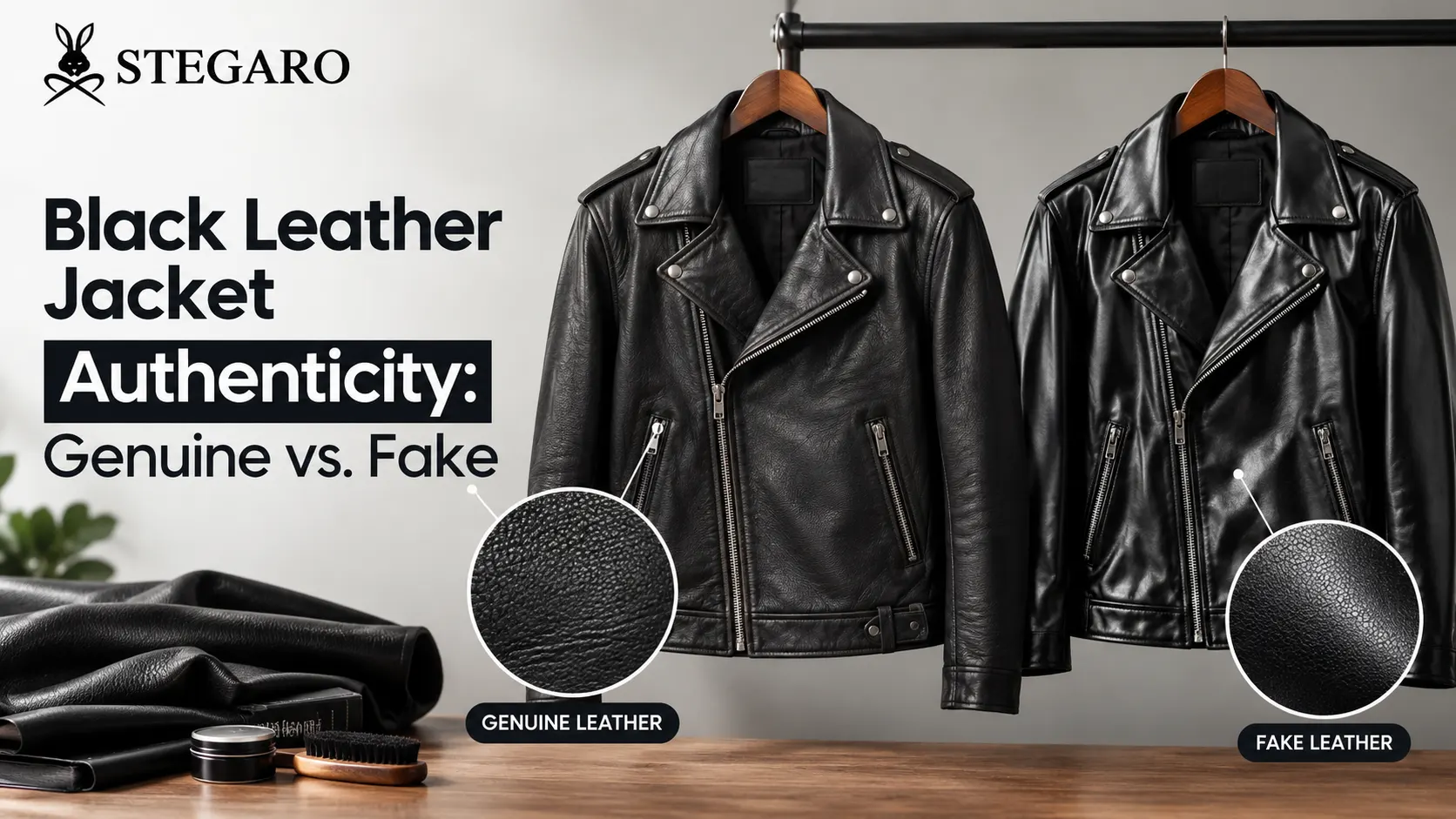
Take the jacket into natural light and look closely at a panel. Genuine leather usually has subtle variation. You may notice some wrinkles, tiny pores, minor texture changes, or natural marks on the jacket. These variations are very normal. A hide came from an animal, so absolute uniformity is not its natural state.
Synthetic leather often has a more repetitive surface. The grain may look almost too consistent, with the same pattern appearing across large areas.
That does not mean every perfectly smooth jacket is fake. Some genuine leather is heavily finished or corrected. Likewise, some high-quality faux leather has an impressively realistic grain. The useful question is whether the texture looks naturally varied or mechanically repeated.
This is especially important when checking a genuine black leather jacket because black pigment and surface coatings can disguise the original grain.
3. Don’t Skip the Touch Test
Take the jacket in your hands and pay attention to how the material feels when you touch it.
Real leather tends to feel flexible, slightly warm to the touch, and substantial. When you bend or gently pinch it, the surface can form small, irregular wrinkles. It should behave somewhat like skin because, well, it came from skin.
Faux leather can feel unusually smooth, rubbery, or plasticky. Some modern synthetic materials are soft and convincing, but texture alone cannot answer the question.
Try pressing the surface lightly with your thumb. A real hide often shows temporary creasing around the pressure point. The material should not feel like a thin plastic sheet stretched over fabric.
Do not confuse stiffness with authenticity. Thick leather can be firm, especially when it’s brand new. For instance, a motorcycle jacket may need some breaking in before it feels flexible to wear.
4. Check an Unfinished Edge
If you have permission to inspect the jacket, look at a hidden or unfinished edge. The inside of a cuff, the underside of a flap, or a seam allowance can reveal more than the outer surface.
Leather has a fibrous structure. A cut edge can look slightly uneven or suede-like, depending on the type of hide and how the piece was constructed.
Synthetic leather usually has a layered structure: a surface coating attached to a textile or another backing material. On an exposed edge, you may see a noticeably uniform plastic layer sitting over fabric.
This is one of the more useful checks when comparing a real leather jacket black with a faux version.
Still, be careful. Many quality jackets have folded, painted, or bound edges, so you may not find an exposed edge at all. However, never cut or damage a jacket just to perform this test.
5. Read the Label, But Do Not Worship It
A product label should provide you useful information, not replace your judgment.
Look for terms such as full-grain, top-grain, split leather, cowhide, lambskin, goatskin, or other specific leather types. If the label simply says “leather” or “genuine leather” without further detail, there is still an important question to ask: what kind?
Also check the composition label. “Leather” and “PU leather” are not interchangeable terms. A jacket made from genuine hide may also contain synthetic materials in its lining, trims, or other components. That is normal. What matters is understanding what the main outer material actually is.
If a seller refuses to provide basic material information, that is more concerning than a jacket simply having a lower grade of leather.
6. Look at the Construction
Authenticity is not only about the hide.
Examine the stitching. Are the seams straight? Are the stitches reasonably even? Do the panels sit correctly? Check the zipper, snaps, buttons, lining, and pocket construction. A genuine leather jacket can still be poorly made.
This is a lesson worth remembering if you are buying a genuine black leather jacket online: genuine material does not automatically equal a great jacket.
Photos can help, but request close-ups when possible. Ask to see the leather surface, label, inside construction, and hardware. A seller who knows the product should be able to answer basic questions without hiding behind vague phrases such as “premium quality.”
7. Be Careful With the Price
Price can raise a useful question, but it cannot prove authenticity.
If a jacket is advertised as a substantial full-grain leather piece for an unbelievably low price, investigate. Quality hides, tanning, skilled cutting, sewing, hardware, lining, and finishing all cost money.
At the same time, an expensive jacket is not automatically genuine. Branding, designer names, marketing, and retail markups can push prices much higher.
Think of price as a clue rather than a test.
For shoppers searching for a real leather jacket black, this matters because convincing replicas can be photographed extremely well. The jacket may look premium on a screen while the actual material is thin synthetic leather.
8. Skip the Viral Burn Test
You may have seen videos recommending a lighter or flame as the ultimate leather test. Do not do it to a jacket you care about.
Heat can damage leather finishes, dyes, adhesives, stitching, and linings. Synthetic materials may melt or deform, while real leather can char, but that does not make a flame test sensible for a finished garment.
The same goes for cutting the jacket open or deliberately spilling water on it. You should not damage a jacket simply to prove what the label should already have told you.
A better approach is simple: combine smell, grain, touch, edge inspection, labeling, construction, and seller information.
How Black Leather Ages: Another Clue
One of the most satisfying things about a real leather jacket is watching it change.
With regular wear and proper care, leather can soften and develop character. Creases form around the elbows and shoulders. Some areas with higher friction may become a little smoother or have a tiny tonal difference.
Faux leather ages in a different way. Depending on the quality and polish, it may eventually crack, peel, or lose its surface coating.
So, age is not a perfect indicator of authenticity either. Low-grade real leather can go off rapidly, whilst good-quality synthetic materials can last for years.
If your goal is a genuine leather jacket black that you plan to wear for a long time, think about longevity from the beginning. Ask about leather type, thickness, finish, care instructions, and warranty rather than focusing only on whether it passes one authenticity trick.
What Should You Buy?
The answer depends on what you value.
If you want natural material, long-term wear, and the way leather develops character, a genuine leather jacket can make sense. If price, animal-free materials, or a particular lightweight finish matters more to you, modern faux leather may be perfectly suitable.
There is no need to pretend every genuine leather jacket is automatically superior in every situation. Material quality and construction still matter.
For a genuine black leather jacket, check the leather type first, then the construction, then the seller. Those three details tell you far more than a product title filled with words like “luxury,” “premium,” or “authentic.”
And if you are shopping specifically for a real leather jacket black design, remember that the classic look is not the difficult part. Almost anyone can copy the silhouette. The real difference is hiding in the material, stitching, hardware, and finishing.
Final Checklist Before You Buy
Before paying, run through this quick list:
- Does the material have a natural, leather-like smell rather than a strong plastic smell?
- Does the grain show subtle variation?
- Does the surface crease naturally when gently pressed?
- Can you identify the leather type?
- Does an exposed edge show a fibrous leather structure?
- Are the seams, zipper, lining, and hardware well made?
- Does the seller provide clear material information?
- Does the price make sense for the claimed leather and construction?
- Are there close-up photos instead of only polished model shots?
No single test is perfect, but together, they create a much clearer picture.
The goal is not to become a leather detective who carries a magnifying glass into every clothing store. It is simply to slow down before buying. A few minutes of inspection can save you from paying genuine-leather money for a jacket that only looks the part.
FAQs
Check several signs together. Look at the grain for natural variation, feel the material for a skin-like response to pressure, inspect an unfinished edge if available, and smell the jacket. Then verify the label and ask the seller what type of leather was used. No single test is conclusive.
No. Genuine leather means the material is real leather, but it does not mean the jacket is full-grain. Full-grain actually refers to leather that retains the outer surface of the hide. Always ask for the specific leather grade or type rather than assuming “genuine” means premium.
Start with reading the product description and composition label. Look for specific information about the hide, such as cowhide, lambskin, goatskin, full-grain, or top-grain. Then examine close-up photos of the grain, seams, label, and edges. If the seller didn’t mention the product description clearly, contact them directly before ordering.
It is based on how you are going to use it, your budget, and the quality of the jacket. Good leather jackets can last and age beautifully, but good leather doesn’t mean an authentic jacket. Look at the hide, stitching, hardware, fit, and the seller before you choose.
It is better not to. A burn test can damage the jacket and may affect finishes, adhesives, stitching, or lining. Non-destructive tests like touch, grain, smell, labeling, and edge inspection are safer and more practical.
The biggest mistake people make when buying leather jackets is assuming that the word “genuine” guarantees high quality. Authenticity and quality are related, but they are not the same thing. A jacket can contain real leather and still use a lower-quality hide or weak construction. Look at the whole product, not one reassuring word on the label.