
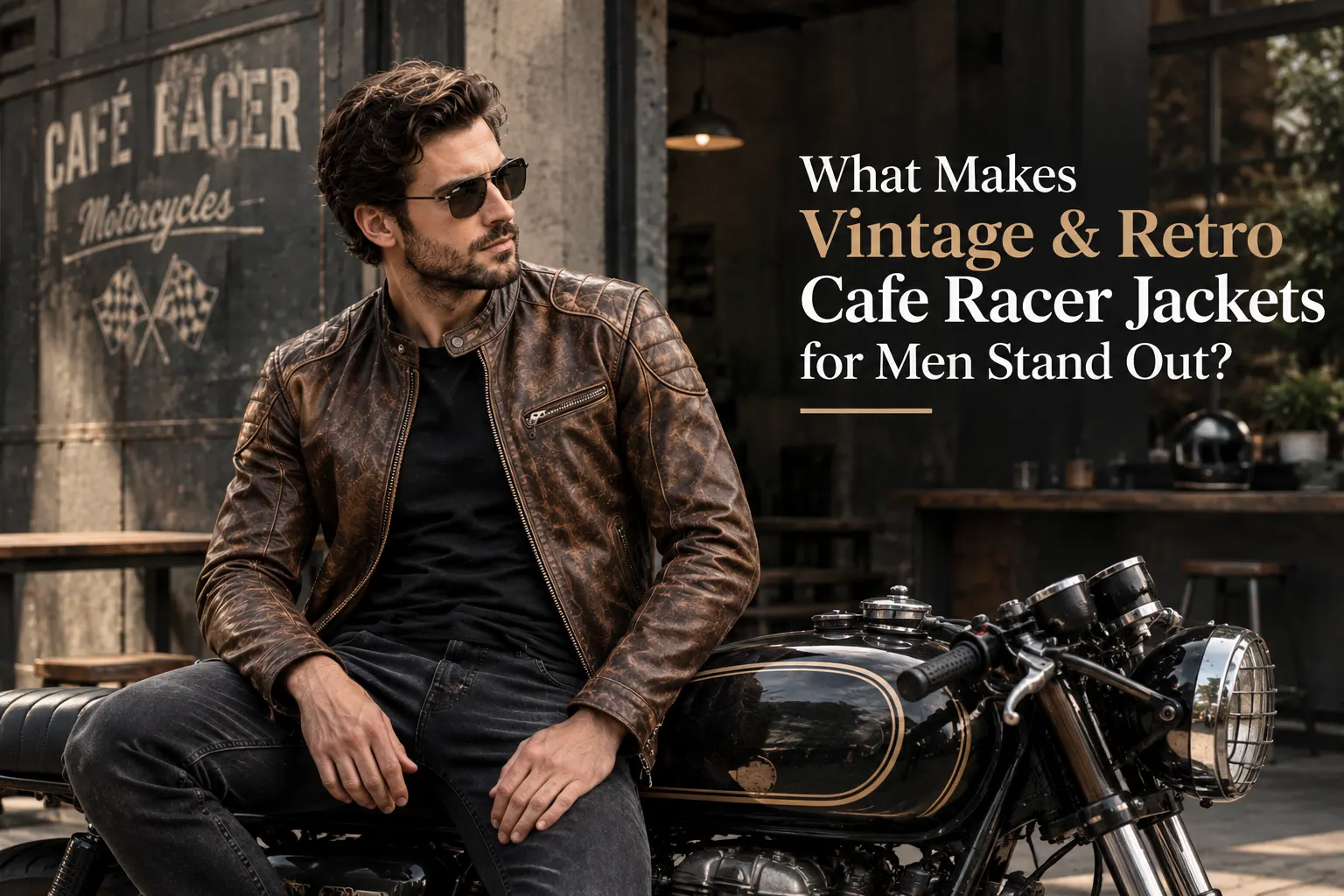
Some jackets look old. Others actually are old. Then there are jackets that borrow the best design ideas from another era and make them work today. That difference is what makes vintage and retro café racer styles compelling.
A vintage café racer jacket can carry small signs of its previous life: softened leather around the elbows, fading near the seams, or hardware that has naturally aged. A modern reproduction cannot honestly recreate every detail, but it can capture the design language that made the style memorable.
The result is a category of menswear that feels less dependent on trends. Instead of asking what is fashionable this season, these jackets ask a more interesting question: why did this design survive in the first place?
Vintage vs. Retro: What Is the Actual Difference?
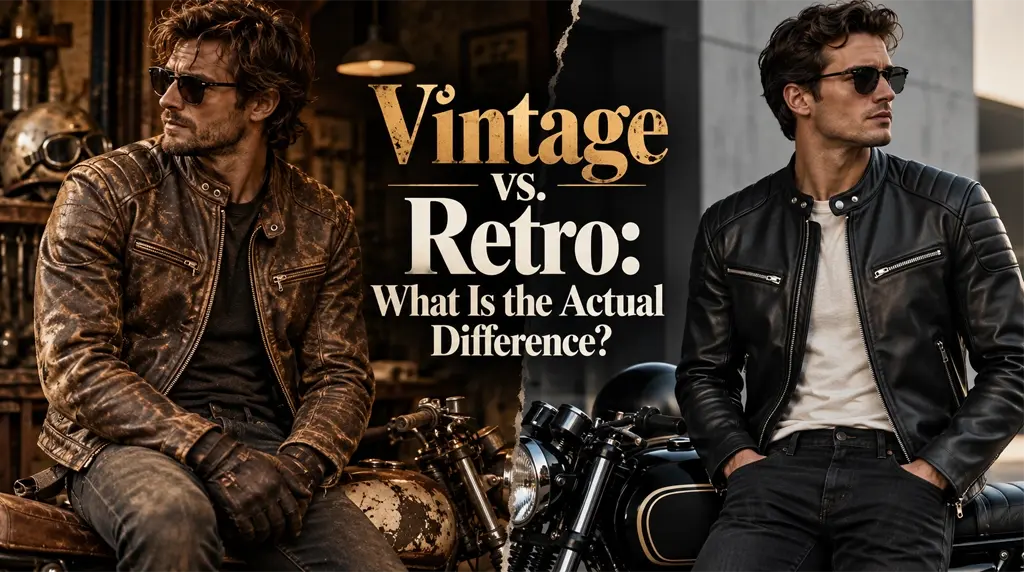
“Vintage” and “retro” are often treated as interchangeable terms, but they are not.
A genuinely vintage jacket is an older garment from a previous period. Its age, construction, labeling, hardware, lining, and wear can give clues to its history. A vintage jacket is fresher but consciously takes visual cues from a previous era.
| Feature | Vintage | Retro |
| Age | Originally made in an earlier era | Newly manufactured |
| Wear | Naturally developed | Usually new or deliberately distressed |
| Hardware | May feature period-specific components | Modern hardware with vintage styling |
| Leather | Aged through time and use | Can be new with an aged finish |
| Availability | Often limited | Easier to reproduce |
| Appeal | Authentic history | Historical influence with modern practicality |
That difference is important because old does not always indicate better. A genuinely vintage jacket can have beautiful leather and remarkable construction, but it may also have tired stitching, damaged lining, or a replacement zipper. Meanwhile, a carefully made modern reproduction can offer stronger everyday reliability.
In other words, vintage is about age and provenance, while retro is about design influence.
Why the Shape Still Matters
Before the leather, the first thing worth examining is the shape. The full breakdown of the collar, zip, and proportions is covered in our guide to what defines a cafe racer jacket, so here the point is simply the restraint. A vintage cafe racer leather jacket does not need oversized lapels, decorative belts, or rows of metal hardware to make an impression. Its appeal comes from proportion, and that restraint is refreshing. Not every leather jacket needs to announce itself from across the street.
Patina Is More Than “Looking Worn”
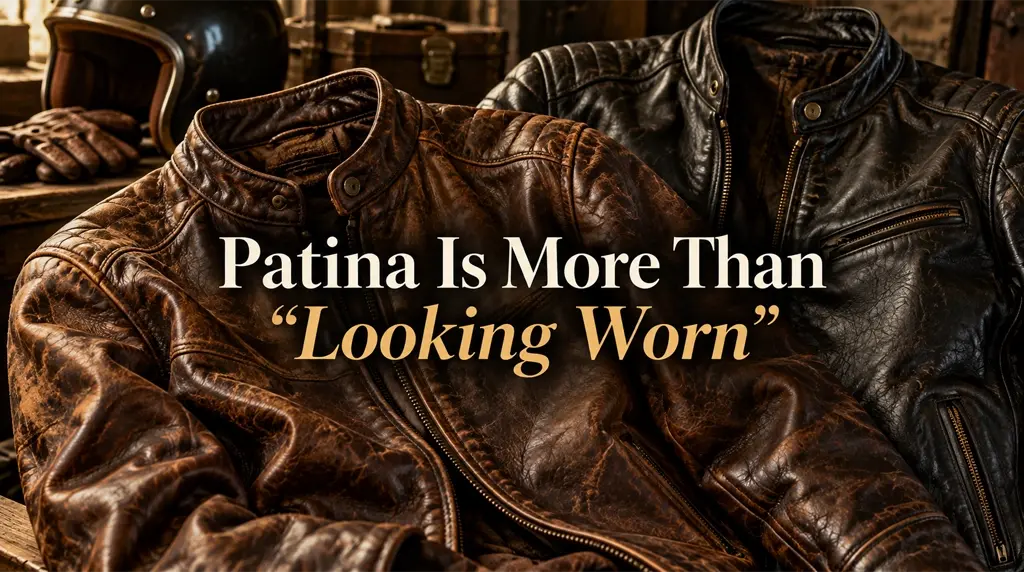
Here is where genuine vintage leather becomes difficult to imitate convincingly.
Patina develops gradually through use, handling, movement, exposure, and time. Creases become concentrated around areas that bend repeatedly. The surface may soften. Certain edges may become lighter or darker. None of these changes necessarily happen evenly.
That unevenness is important.
A vintage cafe racer jacket may show more character around the cuffs, collar, pocket openings, and elbows because those areas naturally receive more contact. The result can look completely different from factory distressing, where wear marks are deliberately placed to create an aged appearance.
Neither approach is automatically superior. The key is understanding what you are looking at.
Leather Finish Changes the Personality
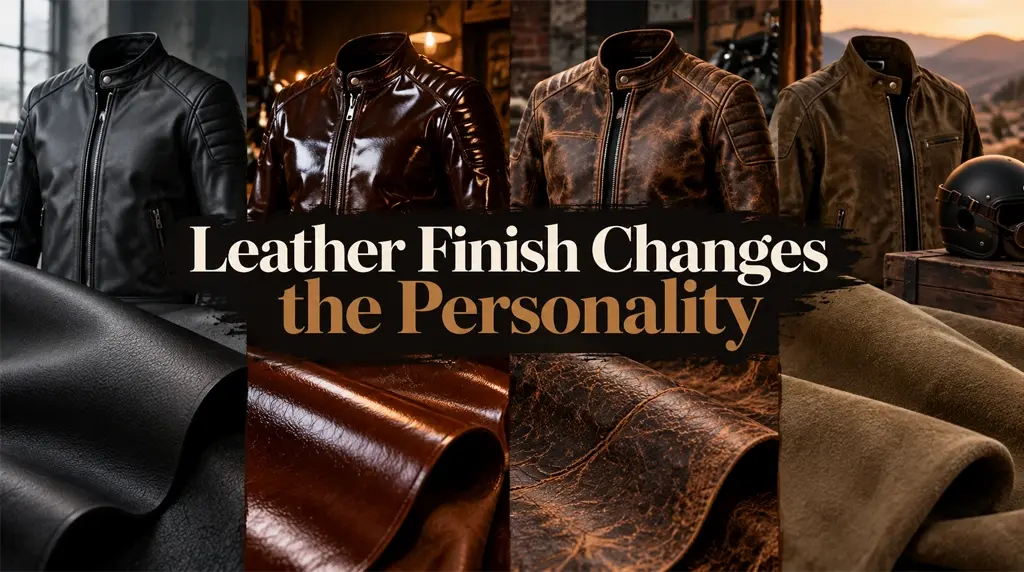
The same café racer pattern can look surprisingly different depending on its leather and finish.
Smooth leather creates a crisp, polished appearance. Matte finishes feel more understated. Waxed or pull-up leather can develop tonal variation when the surface bends, while distressed finishes emphasize an intentionally aged character.
Finish is also not the same as leather grade. Our guide to racer jacket leather types explains grain and hide differences in full, so the practical takeaway here is simply that a “vintage look” and “high-quality leather” are not the same claim.
A vintage cafe racer leather jacket can have a beautiful aged finish without necessarily being made from the highest grade of leather. Likewise, a new jacket made from excellent leather does not become vintage simply because its surface has been distressed.
Hardware Can Tell a Hidden Story
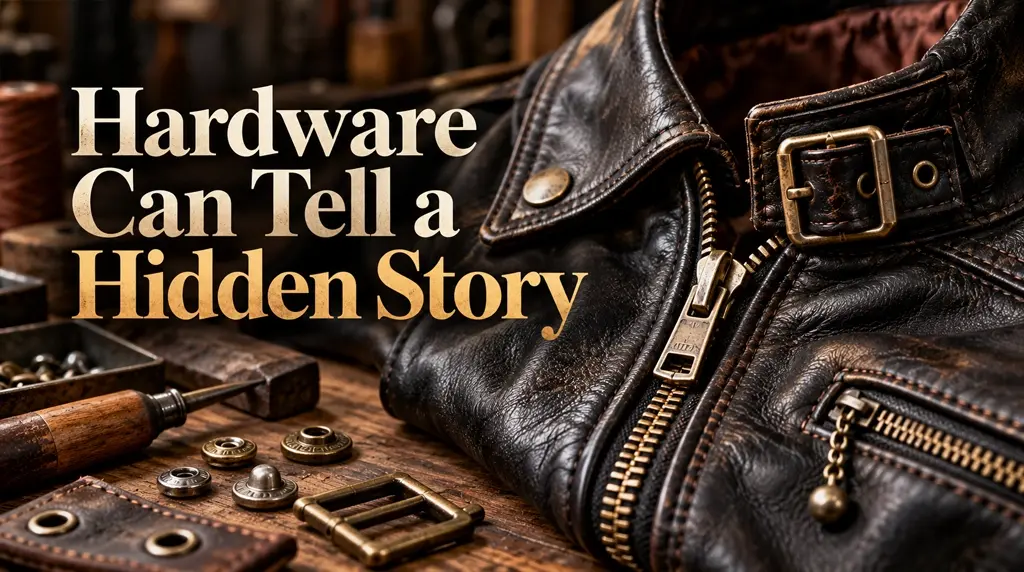
Look closely at the parts people usually ignore.
Zippers, snaps, buckles, labels, lining materials, stitching patterns, and even zipper pulls can provide useful clues about a jacket’s production history. Vintage motorcycle garments show how manufacturers solved practical problems with the materials and hardware available at the time.
But one detail should never be treated as absolute proof.
An old-looking zipper does not automatically establish authenticity. A replacement zipper does not automatically make an old jacket fake. Think of authentication as putting several pieces of evidence together.
That approach is particularly useful when browsing vintage cafe racer jackets. Instead of asking, “Does this look old?” ask, “Do the leather, construction, hardware, labels, and wear all tell the same story?”
That is a much harder question and a much better one.
Why Retro Versions Still Have a Place
Not everyone wants a jacket that has already lived several decades.
A retro cafe racer jacket gives you the recognizable visual language of the past without requiring you to hunt for an original garment. Modern manufacturers can reproduce the stand collar, central zip, compact silhouette, racing-inspired details, and restrained hardware while adapting the jacket for contemporary wardrobes.
The best versions do not copy history piece by piece. They edit it.
The lining may be more practical. The hardware may be cleaner. The leather may be softer. The cut may allow easier movement. These changes can make the jacket feel historically inspired without making the wearer look as though he has stepped out of a motorcycle archive.
That balance is the real strength of retro design. Browse our retro cafe racer jackets for men to see it in practice.
Why the Style Still Feels Current
Vintage and retro café racer jackets have another advantage: they are relatively easy to integrate into modern clothing.
The streamlined shape works with straight-leg denim, chinos, boots, plain T-shirts, knitwear, work shirts, and even tailored trousers. You can emphasize the heritage side with denim and boots, or make the jacket feel contemporary by pairing it with cleaner, more minimal pieces.
This is why vintage cafe racer jackets can appeal to someone who has never owned a motorcycle. The motorcycle influence is visible, but the silhouette does not demand a motorcycle-themed outfit.
One heritage reference is enough. You do not need the jacket, boots, gloves, goggles, and motorcycle all at once.
A heavily distressed new jacket is still new. A relatively clean old jacket can still be genuinely vintage.
How to Style a Vintage Cafe Racer Jacket
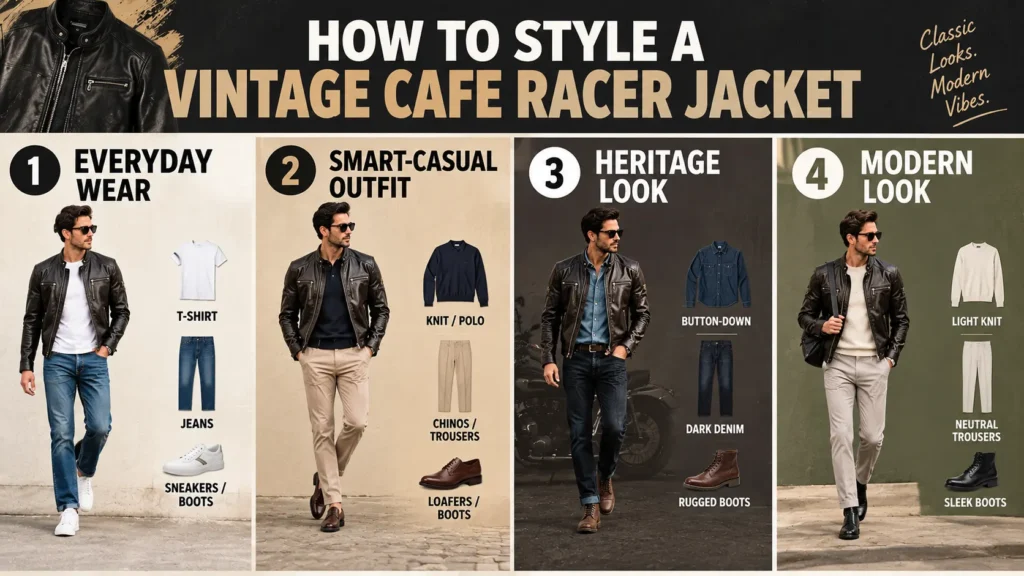
The trick with vintage- and retro-inspired leather is not to make the entire outfit look traditional. Let the jacket carry most of that character, then keep the rest modern and uncomplicated.
- For everyday wear: Pair it with a plain T-shirt, straight-leg jeans, and leather sneakers or simple boots. Blue denim creates a classic contrast, while black denim gives the outfit a sharper edge.
- For smart-casual outfits: A fine-gauge knit or polo with chinos or tailored trousers will work for casual dressing. This approach is especially effective if the jacket has a clean finish rather than a lot of heavy distressing.
- For a stronger heritage look: Add dark denim, rugged boots, and a simple button-down for a more heritage-heavy look. Keep accessories restrained so the outfit feels authentic rather than costume-like.
- For a modern look: Opt for a cleaner jacket with less distressing and pair it with neutral trousers, a lightweight knit, and sleek boots. The outfit is kept fresh with a mix of old-school silhouette and contemporary pieces.
A useful rule is simple: one or two vintage references are usually enough. If everything looks deliberately aged, the outfit can start feeling like a costume. The jacket should suggest its heritage, not shout about it.
What Actually Makes One Stand Out?
The most interesting jackets usually combine several characteristics rather than relying on one gimmick.
| Detail | Why It Matters |
| Compact silhouette | Creates the recognizable café racer profile |
| Stand or band collar | Keeps the neckline clean |
| Straight center zip | Gives the front a balanced appearance |
| Natural patina | Adds individual character |
| Quality leather | Influences feel, aging, and appearance |
| Period-inspired hardware | Strengthens the heritage impression |
| Restrained detailing | Prevents the design from becoming costume-like |
| Good construction | Determines how well the jacket holds up |
The important word here is coherence.
A jacket becomes convincing when its shape, leather, hardware, and finishing feel as though they belong together. A random vintage zipper attached to a modern-looking jacket does not create heritage. Neither does artificial fading alone.
Vintage Character or Modern Reliability?
There is no universal winner.
If you enjoy finding unusual garments with genuine history, a vintage piece can be incredibly rewarding. Every crease and repair may tell you something about its previous life. The downside is that condition varies, and replacement parts or restoration can become part of the ownership experience.
A modern retro version makes more sense when you want consistency. You know what you are buying, the construction is contemporary, and you can enjoy the old-school aesthetic without worrying about whether a fifty-year-old lining will survive another season.
| Choose Vintage If You Want | Choose Retro If You Want |
| Genuine age | Vintage-inspired design |
| Natural wear | A clean starting point |
| Provenance | Modern construction |
| Individual imperfections | Consistency |
| Collector appeal | Everyday practicality |
Neither choice is pretending to be the other. That is exactly why both remain relevant. Prefer a warm heritage tone? Read how brown cafe racer jackets elevate your style.
Final Thoughts
The appeal of vintage cafe racer jackets goes deeper than simply making a new garment look old.
A well-chosen vintage cafe racer leather jacket carries traces of motorcycle culture, material history, craftsmanship, and real-world wear. A thoughtfully designed retro version takes those same visual principles and translates them into something more practical for today’s wardrobe.
That is what ultimately makes the style stand out: the design has history, but it does not need to live in the past.
Whether you prefer naturally aged leather or a cleaner modern interpretation, Stegaro shows why restrained leather design continues to hold its ground when trend-driven pieces come and go.
FAQs
Its identity comes from the combination of a streamlined silhouette, simple stand or band collar, straight front zipper, compact profile, and restrained detailing. The vintage look comes from the real age of the jacket and its naturally aged character.
No. In fashion marketing, the phrase is frequently used loosely. A truly vintage garment will have several qualities that are consistent with its purported age, including construction, hardware, labels, materials, and natural wear.
Not automatically. Vintage jackets can offer genuine character and historical construction, but condition varies considerably. A modern jacket may provide more reliable construction, cleaner materials, and easier everyday wear.
A retro cafe racer jacket is a modern twist on a vintage cafe racer jacket. As a rule, it borrows details like the stand collar, straight center zip, compact form, and low-key motorcycle vibe without truly being a vintage piece.
Keep the heritage reference handy. Pair the jacket with current jeans, plain knitwear, clean boots, or tailored pants rather than trying to recreate the whole historic motorbike look. The appearance stays fresh thanks to the juxtaposition between old-school jacket design and modern apparel.